
I once watched a client hover over a salon chair for ten minutes, phone full of pixie photos, completely unsure which one would suit her cowlick. That hesitation is normal, because short pixie styles vary far more than most people expect. Sides can run from a quarter inch to two inches, and bangs can be wispy, blunt, or swept off the forehead. This guide covers 20 short pixie styles, each with the face shape, hair texture, and upkeep schedule it suits best. Ready? Let’s explore all 20 of them.
Quick Answer: For fine, straight hair, start with a textured pixie with side-swept bangs. For round faces, pick a cut with height on top and tapered sides. For curls or coils, choose a tapered pixie that keeps length on top. Expect a trim every 4-6 weeks with any of them.
Why Short Pixie Styles Are Worth Your Time
A pixie takes more thought at the consultation than at home. Once the shape is right, daily styling often drops to under five minutes, and you stop fighting with a ponytail on bad hair days. Many people with fine hair are surprised that cutting length can make strands look denser, because the weight no longer drags the hair flat against the scalp.
The less-discussed fact is that pixies are very sensitive to the haircut itself. A cut with the wrong layering looks limp on you, but the same length cut with the right internal texture looks intentional. Bring photos, and be honest about your hair’s density and any cowlicks.
These styles suit people who want lower maintenance in the morning and don’t mind regular salon visits. They are less ideal if you want to tie your hair back for workouts or you dislike trims every month. If you’ve worn a bob for years and want a change that isn’t too extreme, a longer pixie or a bixie is a gentler first step.
One honest caveat: very short sides show your hairline, ears, and neck. That can feel exposed for the first week or two, so factor that into your decision.
At a Glance
- Most short pixie styles need a trim every 4-6 weeks to hold their shape.
- Fine hair usually does best with soft, wispy layers on top rather than blunt lines.
- Curly and coily textures need extra length on top, around 2-3 inches, so curls can form.
- Styling takes 3-7 minutes with a small amount of paste, cream, or pomade.
- Color adds dimension to a short cut, but bleaching needs a professional and a bond-repair routine.
| Style | Best Face Shape | Hair Type | Maintenance | Length |
| Classic Tapered Pixie | Oval, heart | Straight, wavy | Every 4-5 weeks | 2″ top |
| Textured Pixie, Side-Swept Bangs | Square, oval | Fine, straight | Every 5-6 weeks | 2.5″ top |
| Bixie | Round, long | Wavy, medium | Every 6-8 weeks | 4″ top |
| Undercut Pixie | Oval, heart | Thick, straight | Every 3-4 weeks | 3″ top |
| Curly Pixie | Round, heart | 3A-3C curls | Every 6 weeks | 3″ top |
| Pixie Shag | Oval, square | Wavy, thick | Every 6 weeks | 3″ top |
| Micro Fringe Pixie | Oval, long | Straight, fine | Every 3-4 weeks | 1.5″ top |
| Silver Pixie | Any | Straight, wavy | Every 5 weeks | 2″ top |
| Platinum Cropped Pixie | Oval, heart | Straight | Every 4 weeks | 1.5″ top |
| Asymmetrical Pixie | Round, oval | Straight, wavy | Every 4 weeks | Uneven |
| Tapered Natural Cut | Oval, round | 4A-4C coils | Every 3-4 weeks | 1-2″ top |
| Feathered Pixie | Oval, long | Fine, thinner | Every 5 weeks | 2″ top |
| Spiky Pixie | Heart, oval | Thick, straight | Every 4 weeks | 1.5″ top |
| Quiff Pixie | Round, square | Thick, straight | Every 4 weeks | 3.5″ top |
| Buzzed Pixie | Oval, strong features | Any | Every 2-3 weeks | 0.25-0.5″ |
| Balayage Pixie | Oval, heart | Straight, wavy | Every 6 weeks | 2.5″ top |
| Copper Red Pixie | Heart, oval | Straight, wavy | Every 5 weeks | 2″ top |
| Height-Boosted Pixie | Round | Medium, straight | Every 4-5 weeks | 3″ top |
| Soft Wispy Pixie | Square, long | Fine, wavy | Every 5 weeks | 2″ top |
| Pixie With Curtain Bangs | Oval, long | Straight, wavy | Every 6 weeks | 3″ top |
1. Classic Tapered Pixie With Short Sides

This is the original, and it works because everything is proportional. Ask your stylist for sides tapered to about half an inch, with 2 inches left on top.
The cut suits oval and heart-shaped faces and straight to slightly wavy hair. It needs a trim every 4-5 weeks; at week six the tapered neckline starts to look fuzzy. I once stretched it to eight weeks and the shape lost all its definition.
Pro Tip: Use a pea-sized amount of matte paste on damp hair, not dry. Damp application spreads evenly through the short layers, so the top doesn’t clump.
Read more about pixie cuts for fine hair. This guide to pixie cuts from Allure shows how stylists vary the taper.
Start here if you want one reliable cut to build from.
2. Textured Pixie With Long Side-Swept Bangs

Longer front pieces, around 4 inches, sweep across the forehead and soften angular jaws. Point-cutting, where the stylist snips vertically into the ends, creates the texture without taking away density.
- Best for: fine, straight hair and square or oval faces.
- Skip if: your hair is very coarse, since the bangs tend to stick out.
- Upkeep: a trim every 5-6 weeks and a sea-salt spray for grip.
See our notes on low-maintenance short haircuts. For more on bang styling, read Byrdie’s pixie breakdown.
Fine hair loves the movement this one adds.
3. Bixie Cut (Bob-Pixie Hybrid)

A bixie keeps pixie layers on top but leaves 3-4 inches at the nape, so it still tucks behind ears. It’s a good bridge if you’re nervous about going fully short.
It works on round and long faces and on wavy hair with medium density. Trims can stretch to 6-8 weeks, which is the main reason people love it.
Pro Tip: Blow-dry the back section with a round brush turned under at the ends. Without that, the nape layers flip out and the “bob” half disappears.
Browse short layered haircuts. For salon wording, Who What Wear’s bixie guide is helpful.
Choose this if you want a low-risk way into short hair.
4. Undercut Pixie With Shaved Nape

The top stays long, around 3 inches, while the nape and sides are clipped to a #1 or #2 guard. The contrast lets thick hair feel lighter, since a lot of bulk is removed.
Ask for the undercut to start above the occipital bone so it stays hidden when you want it covered. This cut grows out visibly fast, so plan on a refresh every 3-4 weeks.
Not ideal if your office has strict grooming norms, since the shaved nape is obvious when your hair is up.
Pair it with statement earrings to balance the edge. For more cut ideas, see Allure’s undercut guide.
If you like crisp lines, you’ll enjoy this one.
5. Curly Pixie for 3B-3C Curls

Curls shrink when cut, so leave 3 inches on top to get a real curl pattern rather than a flat cap. Ask for dry cutting, because curls sit differently wet.
Wash-day routine stays simple: a lightweight leave-in and a gel scrunched in while soaking wet. Skip brushing; a wide-tooth comb on wet hair is enough. Round and heart faces gain width at the crown, which flatters them.
Pro Tip: Sleep with a satin bonnet or pillowcase. Cotton roughens the cuticle and the curls frizz by morning.
More ideas in curly short hairstyles. The Allure curly hair guide covers product layering.
Trust the curl, and let it grow in its own direction.
6. Pixie Shag With Choppy Layers

Think of it as a shag compressed into pixie length. Short, jagged layers around the crown create movement, and wispy pieces fall over the ears.
- Best for: wavy, thick hair; oval and square faces.
- What to ask for: “razor-cut layers, heavy texture, 3 inches on top.”
- Avoid if: your hair is very straight and fine, since razor cuts can look stringy.
A texturizing spray and finger-tousling are all it needs. Trim every 6 weeks.
Our shag haircut ideas go deeper. For inspiration, see Elle’s shag roundup.
It looks best when you stop trying to make it tidy.
7. Blunt Micro Fringe Pixie

A micro fringe is cut about an inch above the brows and demands precision. It’s striking on oval and long faces because it shortens the forehead visually.
It suits straight, fine hair best. Cowlicks at the hairline will fight you, so ask your stylist to check your hairline growth pattern before cutting.
Pro Tip: Book a fringe trim between full cuts, usually every 3 weeks. Many salons do it free or for a few dollars, and it keeps the line sharp.
For more on bangs, see our bangs for every face shape. Vogue’s bang guide explains the commitment involved.
It looks bold, and it’s honest work to maintain.
8. Silver Gray Pixie

Gray hair is often coarser and drier, which actually helps a pixie hold its shape. Keep the top at 2 inches with soft layers so the silver catches light.
Yellowing is the usual complaint. A purple shampoo once a week counters it, but leave it on for no more than 3 minutes or the color turns lilac-ish. I learned that the hard way.
Works on nearly any face shape, and trims every 5 weeks keep it crisp.
Try pairing it with the best lip colors for silver hair. Harper’s Bazaar on going gray has solid transition advice.
Let the natural color do the work.
9. Platinum Cropped Pixie

Platinum on short hair is manageable because there’s little length to damage. Still, going from dark brown to platinum takes two to three sessions, and rushing it can cause breakage.
Book a professional, and ask about bond-repair treatments. Plan for a root touch-up every 4 weeks, and a toning gloss every 6-8. Salon cost often runs 150-300 per visit.
Pro Tip: Shampoo only twice a week. Bleached hair is porous, and frequent washing flattens the tone to yellow.
See our blonde hair color ideas. Byrdie’s bleach guide explains the process realistically.
Worth it if you love upkeep.
10. Asymmetrical Pixie

One side is clipped shorter, the other left long. The imbalance creates angles that slim round faces and add interest to oval ones.
- Beginner version: a 1-inch difference between sides.
- Bolder version: a 3-inch difference with a deep side part.
- Watch for: growth patterns, since uneven hair grows into different shapes.
Style with a flat iron or texture cream to keep the long side clean. Plan trims every 4 weeks, because the contrast softens quickly.
Ideas to try next: asymmetrical haircuts for women. Elle’s asymmetric cut feature shows modern variations.
It’s an easy way to look different without changing length.
11. Tapered Natural Cut for 4A-4C Hair

Tapering shortens the sides and nape while leaving 1-2 inches on top, which defines the coils. A barber experienced with textured hair makes a big difference here.
Moisture is the priority. Use a water-based leave-in followed by a light oil, and avoid heavy gels that cause flaking. Trim every 3-4 weeks to keep the edges sharp.
Pro Tip: Ask for a “shape-up” of the hairline only if you’re comfortable maintaining it, since it needs refreshing every 2 weeks.
See our short natural hairstyles. The American Academy of Dermatology hair care tips are useful for scalp health.
Strong, simple, and flattering on nearly every face.
12. Feathered Pixie for Fine, Thinner Hair

Feathering uses soft, short layers that overlap so fine hair looks fuller at the crown. The cut avoids heavy blunt lines, which can reveal sparse areas.
Ask for “soft, feathered layers with 2 inches on top” and a volumizing mousse worked in at the roots. Dry shampoo at the crown adds grip on day two.
If you’ve noticed sudden or patchy thinning, see a doctor or dermatologist rather than relying on a haircut. A pixie can work with fine hair but won’t change the cause.
Find more in haircuts for thin hair. Allure’s fine hair advice covers cutting techniques.
Light layers and a lighter touch go a long way.
13. Spiky Gelled Pixie

Short, defined spikes work on thick, straight hair that holds a shape. The top is cut to roughly 1.5 inches and styled upward with a strong-hold gel.
Heart and oval faces carry it best, because the volume at the crown balances a narrow chin. Apply gel to damp hair, blow-dry upward, then finish with a pinch of clay to separate pieces.
Pro Tip: Rinse thoroughly each night. Gel buildup dries out the scalp and leaves flakes that show against dark hair.
Take it down a notch with soft makeup looks for short hair. GQ’s grooming section lists strong-hold products worth testing.
A great pick when you want attitude.
14. Quiff Pixie With Volume on Top

The quiff leaves 3.5 inches on top, brushed upward and back, with sides kept short. The height lengthens round and square faces visually.
- Product: a light pomade and a blow-dryer with a small nozzle.
- Technique: dry the front upward with a round brush, then set with the cool shot.
- Limit: needs thick or medium-density hair to hold height.
Plan trims every 4 weeks, as the sides lose shape quickly.
For a related look, explore short hairstyles for round faces. Esquire’s quiff styling advice breaks down the technique.
Great for days you want more presence.
15. Buzzed Pixie (Ultra-Short Crop)

This is the most dramatic option, usually cut with a #2 or #3 guard (about 0.25-0.4 inch). It’s best on people with defined cheekbones, strong jawlines, and a well-shaped head.
Expect to see your scalp, so SPF on the scalp matters outdoors. Clippers at home cost around 30-60, and a touch-up every 2-3 weeks keeps it even.
Before committing, ask your barber to do a test with a longer guard first. You can always go shorter, but never longer.
Pair it with bold earrings and eye makeup. Vogue’s shaved-head feature shows the range of looks.
It takes confidence, and the payoff is real freedom.
16. Balayage Pixie With Soft Highlights

Balayage on short hair means only a few hand-painted pieces, concentrated at the top and fringe. That gives the cut depth without a hard regrowth line.
A single session usually costs 120-250 and lasts about 3-4 months before needing a refresh. I found that fewer, brighter pieces look more natural than many subtle ones on cuts this short.
Use a color-safe shampoo and a weekly mask. Trim every 6 weeks.
Find hair color ideas for short hair. Who What Wear on balayage shows how it translates to short lengths.
A subtle way to make a cut feel new.
17. Copper Red Pixie

Copper looks strongest on warm and neutral undertones; on cool undertones it can wash out unless the shade leans toward auburn. Ask for a custom blend rather than a box dye.
Red fades fastest of all colors, often within 4 weeks of washing. Rinse in cool water, use a sulfate-free shampoo, and book a gloss refresh at 5 weeks. A salon visit typically runs 100-200.
Wear it with green, cream, and navy for contrast.
Explore our best colors for warm undertones. Byrdie’s red hair guide covers fading prevention.
Bright, bold, and surprisingly wearable.
18. Height-Boosted Pixie for Round Faces
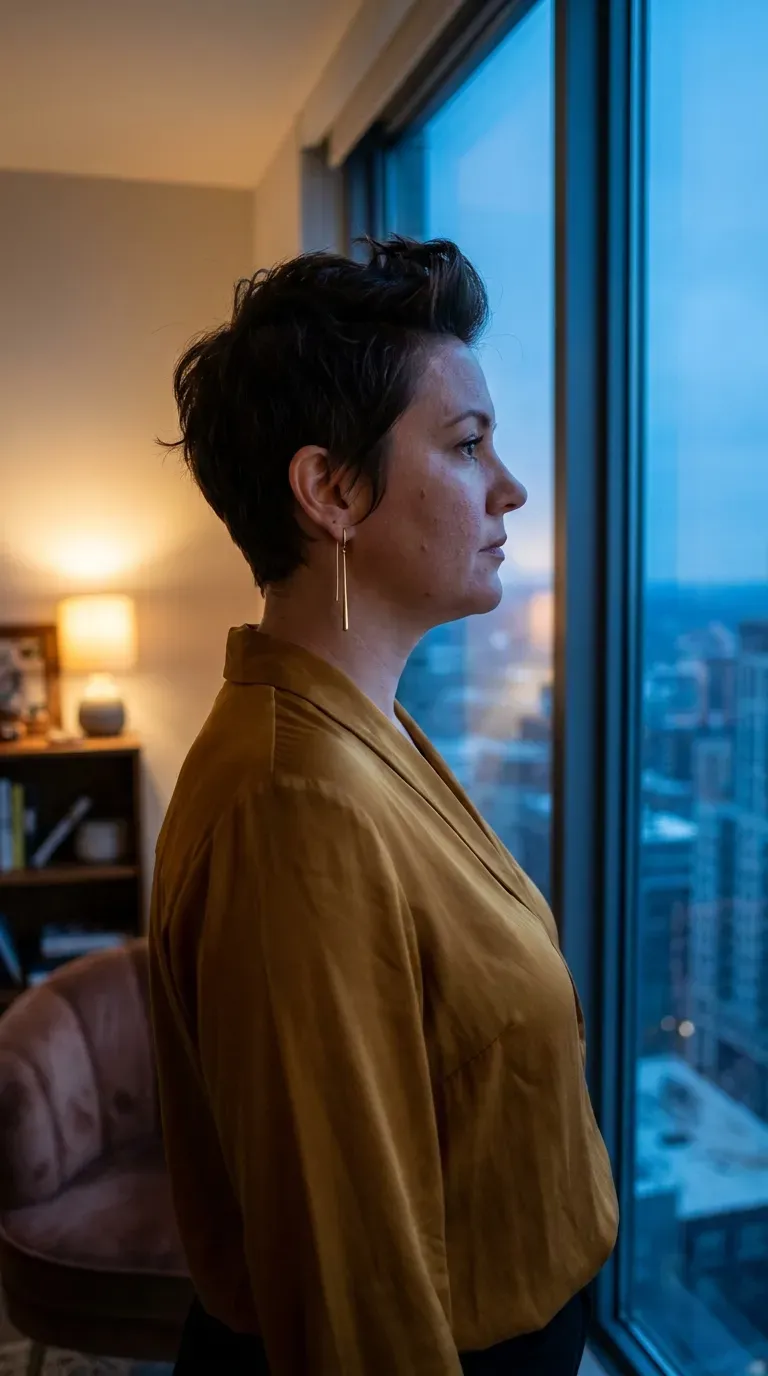
Round faces look longer when volume sits on top and the sides stay close to the head. Ask for 3 inches at the crown, tapered sides, and no heavy fullness at the cheeks.
- Do: lift the roots with mousse and a blow-dryer.
- Do: choose side-swept fringe over a full one.
- Avoid: chin-level wispy sides, which draw attention to the widest part of the face.
Long, linear earrings add to the effect. Trim every 4-5 weeks.
More options in short hairstyles for round faces. Allure’s face shape guide explains the geometry.
Simple proportion rules do most of the work here.
19. Soft Wispy Pixie for Square Jaws

Wispy pieces around the ears and temples soften a strong jawline without hiding it. The key is feathered ends rather than blunt ones, since blunt lines echo the angles of the jaw.
Ask for “soft, broken-up layers around the face” and keep the top about 2 inches. Light, airy products like a texturizing spray work better than heavy waxes.
Pro Tip: Skip tight tucking behind the ears. Leaving a little fringe in front of them keeps the jaw softer.
Combine with soft makeup looks for strong jawlines. Elle’s square face haircut ideas give more options.
Gentle shaping brings out the best of a strong face.
20. Pixie With Curtain Bangs

Curtain bangs split in the center and sweep to each side, which makes them the easiest bangs to grow out. They frame oval and long faces and soften a short cut.
- Length: bangs around cheekbone level, 3 inches on top.
- Styling: blow-dry outward with a small round brush.
- Trade-off: they fall flat on very oily scalps, so wash every 1-2 days.
Trim every 6 weeks. Grow-out is smooth because the pieces blend into the layers.
See also bangs with short hair. Harper’s Bazaar on curtain bangs explains the cut clearly.
A good choice if you’re undecided about bangs.
Getting Started With Short Pixie Styles
The easiest first step is a consultation without scissors. Book a 15-minute chat, and bring three photos plus a note about your hair’s quirks: cowlicks, thinning areas, or how it behaves in humidity.
The most common beginner mistake is choosing a cut from a photo of someone with different texture or density. A pixie on thick, straight hair looks nothing like the same cut on fine, wavy hair. Ask your stylist if the cut will behave on your hair, and trust a candid answer over a flattering one.
Buy one product first: a texturizing paste or cream, around 15-25. It does most of the work for the least money.
For timelines, expect the first week to feel strange. By week three you’ll know how to style it. If you want to grow it back out, a pixie takes about 8-12 months to reach chin length, so plan for the awkward middle with clips and headbands.
Frequently Asked Questions
What are the best short pixie styles for fine hair?
A textured pixie with soft layers and side-swept bangs is usually best. Keep 2-2.5 inches on top and avoid heavy blunt lines, which can make fine hair look flat. A volumizing mousse at the roots helps.
How often do short pixie styles need a trim?
Most need a trim every 4-6 weeks to keep their shape. Undercuts and fades may need visits every 3-4 weeks, while longer bixies can stretch to 6-8. Skipping appointments usually turns the cut shapeless within two months.
Do short pixie styles suit round faces?
Yes, with the right proportions. Choose height on top and tapered sides, and avoid fullness at the cheeks. A side-swept fringe also helps elongate the face.
Are short pixie styles low maintenance?
Daily styling is quick, often 3-7 minutes, but salon visits are frequent. If you dislike regular trims, a bixie or pixie with curtain bangs suits better. Color adds extra upkeep.
How long does it take to grow out a pixie cut?
Expect roughly 8-12 months to reach chin length, since hair grows about half an inch per month. A bixie or curtain bangs can make the transition easier. Regular shaping trims keep the in-between stages tidy.
A Few Final Thoughts
These 20 short pixie styles prove that “pixie” is a whole category, not one haircut. Whether you want a classic taper, a curly crop, or a bold copper shade, there’s a version suited to your face and texture. A single appointment can change how your hair, and your morning, feels. Take your photos, be honest about your hair, and pick the one that fits your routine, not just your mood board. Then book the chair and enjoy the first walk out of the salon.