
Thick hair doesn’t lack anything; it just has too much of it in the wrong places. One humid afternoon and the bottom third swells into a triangle while the roots sit flat under their own weight. The right haircuts for thick hair fix this with structure instead of product, removing bulk from the mid-lengths and keeping just enough weight at the ends to hold a shape. Below are 15 cuts that stay smooth and controlled, from precise bobs to shaped shags and curly cuts, each with honest upkeep notes. Ready? Let’s explore all 15 of them.
Quick Answer: For straight thick hair, a graduated bob or soft layered lob keeps the shape tidy. Wavy and curly textures do best with a shaped shag or rounded curly cut. If you want the least styling time, a tapered pixie or undercut bob removes the most bulk. Skip blunt one-length cuts with no internal shaping, since they tend to widen at the ends.
Why Haircuts for Thick Hair Are Worth Your Time
Thick hair and coarse hair are different things. Thick means a high number of strands; coarse describes how wide each strand is. Many people have both, and the combination is what makes hair feel heavy, dry and hard to tame.
A good cut handles bulk before you pick up a dryer. Removing weight from inside the shape lets the outer layer collapse smoothly instead of pushing outward, which is why low-maintenance haircuts for thick hair often cut your blow-dry time in half.
Here’s the lesser-known part: puffiness is usually a weight-distribution problem, not a product problem. When the mid-lengths carry more bulk than the ends, hair flares sideways. Shift that weight and the same hair sits flat without any smoothing serum.
These cuts suit anyone fighting a triangle shape, frizz at the ends, or a blow-dry that takes forty minutes, whether you want short haircuts for thick hair or length with movement. One limit: very thin or thinning hair needs a different approach.
At a Glance
- Internal layers remove bulk from underneath without changing the visible length.
- Bobs with a tapered nape stop the triangle shape before it starts.
- Pixies and undercut bobs cut daily styling to under ten minutes.
- Curly and coily textures need dry-cut shaping, not a standard wet trim.
- Thinning shears used heavily on the ends create frizz, so ask for slide-cutting or point-cutting instead.
| Style | Best Face Shape | Hair Type | Maintenance | Length |
| 1. Long Layers with Internal Weight Removal | Oval, heart | Straight to wavy | Trim every 8–10 weeks | Mid-back |
| 2. Soft Layered Lob | Round, square | Straight to wavy | Trim every 8 weeks | Collarbone |
| 3. Shaggy Layers with Curtain Bangs | Oval, heart | Wavy | Trim every 8 weeks | Chin to shoulder |
| 4. Graduated Bob with Tapered Nape | Oval, square | Straight | Trim every 5–6 weeks | Jaw |
| 5. Undercut Bob with Hidden Nape | Oval, heart | Any texture | Trim every 4–6 weeks | Chin |
| 6. Textured Pixie with Tapered Sides | Oval, heart | Straight to wavy | Trim every 4 weeks | 2–3 in. on top |
| 7. Bixie with Face-Framing Pieces | Round, heart | Wavy | Trim every 5–6 weeks | Cheek to nape |
| 8. Rounded Curly Shape Cut | Oval, heart | Curly | Trim every 10–12 weeks | Chin to collarbone |
| 9. Texturized Collarbone Cut | Round, oval | Straight to wavy | Trim every 8 weeks | Collarbone |
| 10. Modern Wolf Cut | Round, oval | Wavy | Trim every 8–10 weeks | Shoulder |
| 11. Butterfly Cut | Oval, long | Straight to wavy | Trim every 10–12 weeks | Below shoulder |
| 12. Long Curtain Bangs with Blended Layers | Long, square | Straight to wavy | Bangs every 4–5 weeks | Shoulder |
| 13. Blunt Lob with Hidden Layers | Square, round | Straight | Trim every 8 weeks | Collarbone |
| 14. Tapered Cut for Coily Hair | Oval, round | Coily | Trim every 4–6 weeks | 2–4 in. |
| 15. A-Line Bob with Internal Layers | Round, oval | Straight | Trim every 6 weeks | Nape to chin |
1. Long Layers with Internal Weight Removal

Long hair on a thick head gets heavy fast, and hidden layers take out the weight while the length stays put.
Ask for long layers that start at the collarbone, plus “internal” weight removal, where the stylist cuts shorter sections underneath that the top layer covers. Avoid choppy surface layers; they push thick hair outward. My first long cut had layers starting at the chin, and the bottom flared into a bell within a month. Moving them down to the collarbone fixed it.
Dry with the nozzle pointing downward, following the hair’s direction, until it’s about 80 percent dry. Mid-back length works best, with a trim every 8 to 10 weeks and a one-to-two-inch dusting.
Pro Tip: Finish with a cool-air blast over the dried lengths. The cuticle lies flatter when cooled, so the surface stays smooth longer.
See more long layered haircuts for thick hair and read Allure’s hair cutting guide for what to ask your stylist. A good long cut should feel lighter within a week.
2. Soft Layered Lob for Thick Hair

A layered lob is the easiest haircut to wear on thick hair, because it lands where hair stops piling up on the shoulders.
Ask for a collarbone-length lob, roughly 10 to 11 inches long, with soft, long layers that start around the jaw. The layers remove bulk from the mid-section, so the ends hang instead of flaring. On my own thick hair, a cut that ended even half an inch below the collarbone flipped outward every time it touched a coat collar.
- Works: a round brush on the ends, a light leave-in cream, a side part
- Avoid: blunt one-length cuts, heavy silicone serums, stacked layers above the chin
It flatters round and square faces. Browse more lob haircuts for thick hair and see Byrdie’s lob inspiration. Trim it every eight weeks to keep that collarbone line.
3. Shaggy Layers with Curtain Bangs

Shaggy layers give thick, wavy hair somewhere to go, so it collapses into shape instead of ballooning.
Ask for layers that start at the cheekbone, with curtain bangs taken only from the front section. Request point-cutting on the ends for a soft finish, not razoring, which makes thick hair frizz. The first time I tried a shag, my stylist cut too many layers through the back, and I needed three weeks and a lot of mousse before it settled.
Air-dry with a curl cream, or diffuse for ten minutes. The length works from chin to shoulder, and the bangs need tidying every four to five weeks.
Pro Tip: Scrunch with a microfiber towel instead of terry cloth. Rough fibers rough up the cuticle and puff thick hair.
Explore shag haircuts for thick wavy hair and Who What Wear’s shag edit. Start with longer layers if you’re nervous.
4. Graduated Bob with a Tapered Nape for Thick Straight Hair

A graduated bob stops the dreaded triangle by stacking short layers at the nape, which removes bulk where thick hair is heaviest.
Ask for a jaw-length bob with graduated layers at the back, tapering the nape about one inch. The front stays long and clean. Be precise about “graduated”, not “stacked”; stacking too hard on thick, straight hair creates a shelf that sticks out.
This suits oval and square faces and straight hair, and it holds its edge for five to six weeks. Use a paddle brush and a flat iron for a sleek finish, or a round brush for lift.
Browse more bob haircuts for thick hair and see Elle’s bob guide. Book a precise cut and keep up the schedule.
5. Undercut Bob with Hidden Nape
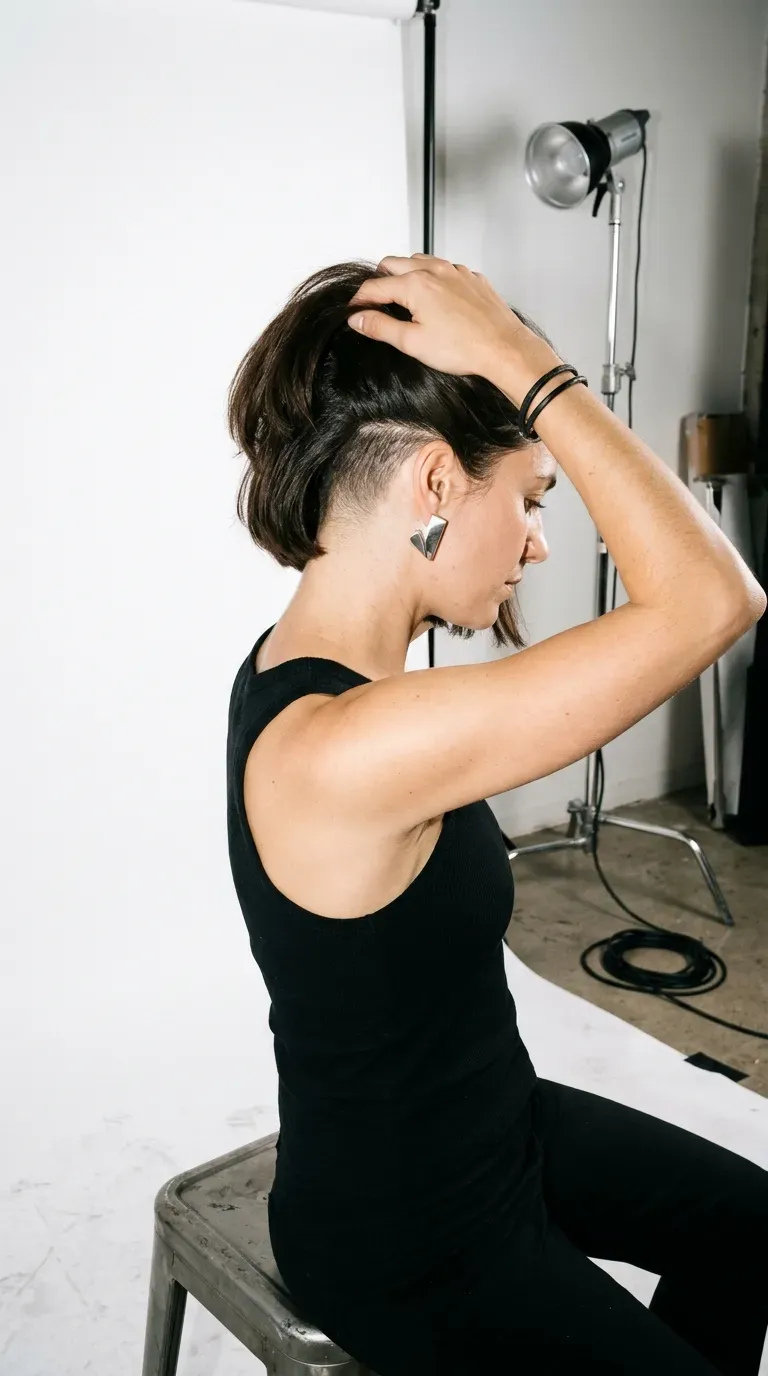
The undercut removes the most bulk of any cut on this list, and nobody sees it when the hair is down.
Ask for a chin-length bob with the nape section clipped to about a quarter-inch (a number 2 guard) underneath, covered by the top layer. When you tie your hair up, the shaved patch shows, so decide if you’re comfortable with that.
It works on any texture and suits oval and heart faces. Plan on a trim every four to six weeks, because the clipped area grows out fast.
Pro Tip: Start with a small undercut, no more than two inches high. You can always remove more, but you can’t put it back.
See more undercut bob haircuts and Byrdie’s undercut explainer. If thick hair has always felt like a helmet, this is the biggest relief.
6. Textured Pixie with Tapered Sides for Thick Hair

A textured pixie cuts the weight away entirely, so thick hair finally sits where you put it.
Ask for tapered sides and back, with two to three inches of point-cut texture on top. Taking the sides down leaves the crown free to lift, which is where thick hair usually hides its volume. Dry it in under five minutes with a fingertip of matte paste.
- Works: matte clay or paste, a quick rough-dry, tapering the sides with clippers
- Avoid: shiny gels, going too short at the crown, heavy razoring
It suits oval and heart faces and straight to wavy hair. Trim every four weeks; a thick pixie grows into a helmet quickly. See more pixie haircuts for thick hair and Allure’s pixie guide.
7. Bixie with Face-Framing Pieces

The bixie sits between a bob and a pixie, and thick wavy hair loves it because the short back strips bulk while the longer front keeps softness.
Ask for a cropped, tapered nape and back with longer, feathered pieces that fall at the cheekbone, and a little length on top for movement. Keep the face-framing pieces light; I once left the salon with them cut too heavy and spent a week pinning them back.
Wavy hair gives it the most body, and it suits round and heart faces. Plan a trim every five to six weeks. Style with a texture spray and your fingers.
Pro Tip: Twist small sections around your finger and hit them with cool air. They set into soft, lifted pieces that survive a commute.
Browse more bixie haircuts for thick hair and see Vogue’s short hair ideas. If you can’t choose between bob and pixie, this is the bridge.
8. Rounded Curly Shape Cut for Thick Curls

Thick curls grow outward, so a rounded shape cut keeps the silhouette balanced instead of widening at the bottom.
Book a curl specialist who cuts dry or on dry-styled curls, so the stylist sees where each curl actually falls. Ask for minimal layering, with a few soft layers that start at the jaw. A cut that ends between chin and collarbone gives curls room to spring up without looking bottom-heavy.
Trim every ten to twelve weeks. Use a curl cream, diffuse on low heat, and avoid brushing dry curls, which turns definition into frizz. Not ideal if you want a smooth blowout, since shaping assumes the curl pattern stays.
Explore curly haircuts for thick hair and Allure’s curl care guide. Pick a stylist whose portfolio shows curls like yours.
9. Texturized Collarbone Cut for Thick Hair

Collarbone length with airy, broken-up ends keeps thick hair light without losing its fullness.
Ask for point-cutting or slide-cutting on the ends and a few long internal layers to take weight out. Heavy thinning shears used all over will make thick, coarse hair frizz, so request them only on the mid-lengths if at all. When mine was cut with thinning shears throughout, the ends fuzzed up within ten days.
Blow-dry with a medium round brush and finish with a light smoothing cream. It suits round and oval faces and straight to wavy hair, and needs a trim every eight weeks.
Pro Tip: Apply smoothing cream to damp hair from mid-length down, never at the roots. Roots stay lifted and the ends stay sleek.
See more haircuts for thick coarse hair and Byrdie’s texturizing tips. Ask your stylist to show you how they’d texturize before they start.
10. Modern Wolf Cut for Thick Wavy Hair

A wolf cut stacks short crown layers over longer lengths, which gives thick hair a place to go besides outward.
Ask for a modern version, with soft, blended layers rather than dramatic choppy ones. Crown layers should start around the cheekbone, with the lengths ending at the shoulder. A harsher wolf cut on thick hair can leave you with a mullet-like bulge, so ask your stylist to blend the transition.
- Works: air-drying with sea-salt spray, diffusing wavy hair, a texturizing cream
- Avoid: heavy razoring, very short crown layers, brushing dry waves
It suits round and oval faces. Trim every eight to ten weeks. See more wolf cut haircuts for thick hair and Who What Wear’s wolf cut guide.
11. Butterfly Cut for Thick Hair

The butterfly cut combines short, face-framing layers with long lengths, giving thick hair bounce without chopping the length.
Ask for layers that start around the chin and blend into a long, mostly one-length back. Keep layers at the front so the back stays dense; too many through the back leaves thick hair stringy. I made that mistake once, and it took four months to grow back.
Blow-dry the front sections with a round brush, rolling away from the face. It suits oval and long faces. A trim every ten to twelve weeks is enough.
Pro Tip: Use hot rollers for 10 minutes on the front layers. The curl sets the lift without roughing up the cuticle.
Explore butterfly haircuts for thick hair and Harper’s Bazaar hair trends. Start with a gentle version if you’re unsure.
12. Long Curtain Bangs with Blended Layers

Curtain bangs frame the face and add shape at the front, which balances thick hair’s tendency to sit heavy at the sides.
Ask for bangs cut from the front section only, with long blended layers that start at the chin. Thick hair makes bangs grow fast and curl at the ends, so ask for them slightly longer than you want and trim down. My bangs once curled upward after a humid day, and I learned to blow-dry them over a round brush every morning.
It suits long and square faces. Bangs need tidying every four to five weeks; most salons do it for free between full cuts. Wash the bangs separately on busy mornings.
See more curtain bangs for thick hair and Elle’s bangs guide. Ask for a consultation before the first cut.
13. Blunt Lob with Hidden Layers

A blunt lob looks sleek, but on thick hair it needs hidden layers underneath to avoid a boxy shape.
Ask for a blunt, straight-across hem just above the collarbone, with internal layers cut beneath the surface to remove weight. Without them, thick straight hair juts out at the ends. I once wore a one-length blunt lob for a month and it looked like a bell until I added hidden layers.
Blow-dry smooth with a paddle brush and a flat iron. It suits square and round faces and straight hair, with a trim every eight weeks.
Pro Tip: Direct the dryer down the hair shaft while brushing. This closes the cuticle, so the surface looks glassy and the ends stay in line.
Browse more blunt lob haircuts for thick hair and Allure’s sleek hair tips. Keep your trim schedule.
14. Tapered Cut for Coily Hair

A tapered cut gives coily hair a clean silhouette, with shorter sides that keep the top from widening.
Ask for a taper at the sides and back, with two to four inches kept on top and shaped into a round or square silhouette. Coily hair often shrinks to half its stretched length when dry, so show your stylist your hair stretched and dry before they cut.
- Works: a leave-in conditioner, a satin bonnet at night, a wide-tooth comb
- Avoid: cutting wet and stretched hair, heavy gels that crunch, over-brushing
It suits oval and round faces. Plan a trim every four to six weeks. Read more about haircuts for thick coily hair and the American Academy of Dermatology’s hair care advice.
15. A-Line Bob with Internal Layers

The A-line bob keeps the nape short and the front long, so thick hair slopes forward instead of flaring outward.
Ask for a short, tapered nape, front lengths ending at the chin, and internal layers cut beneath the surface to thin out bulk. Without those, the back of a thick A-line can stack up into a shelf. I always ask for the nape a touch longer than I think I want, then trim after a week.
It flatters round and oval faces, and straight hair holds the line best. Trim every six weeks to keep the nape from fuzzing out.
See more A-line bob haircuts for thick hair and Byrdie’s bob guide. Take a photo of the back view to your stylist.
Getting Started With Haircuts for Thick Hair
The easiest first step is a consultation, not a cut. Book fifteen minutes with a stylist who works with thick hair, and bring photos of two or three styles you like, plus one you hate. Dry hair tells a stylist more than wet hair does, so arrive with it air-dried.
The most common beginner mistake is asking for “thinning” without knowing what that means. Heavy thinning shears or razors on thick hair can leave frizzy, uneven ends, so ask instead for internal layers, slide-cutting or point-cutting, and describe where hair feels heaviest.
What to buy or book first: one good consultation, then a lightweight leave-in cream and a nozzle for your dryer. A concentrator nozzle focuses the airflow, which flattens the cuticle and shortens drying time.
A realistic timeline: expect your first cut to settle in about a week, once the hair relaxes into its new shape. Most thick-hair cuts need a trim every 6 to 10 weeks to hold their balance, and shorter cuts every 4 to 5 weeks. If a style disappoints, give it two weeks before judging.
Frequently Asked Questions
What is the best haircut for thick hair that won’t puff out?
A graduated bob or soft layered lob with internal weight removal is usually the best choice. Both take bulk out of the mid-lengths while keeping the ends dense enough to hang. Avoid blunt, one-length cuts without internal shaping, which tend to widen at the bottom.
Are layers good for thick hair?
Yes, as long as they are long, soft and cut internally. Layers remove weight so hair collapses inward instead of puffing out. Short, choppy surface layers can push thick hair outward, so ask your stylist to keep them subtle.
How do you stop thick hair from puffing out?
Start with a cut that removes internal bulk, then dry hair with the nozzle pointing down the hair shaft. Finish with a cool-air blast and a light smoothing cream on the ends. Skip heavy oils at the roots, which flatten the crown.
How often should you trim thick hair?
Bobs and shorter cuts need a trim every 4 to 6 weeks, while longer layered styles hold for 8 to 12 weeks. Thick hair loses its shape faster than fine hair because the weight returns quickly. Book the next appointment before you leave.
Is short or long hair better for thick hair?
Both work if the cut removes weight. Shorter cuts like a pixie or undercut bob take away the most bulk, while long layers keep length with less weight. Choose based on how much styling time you want, not just on how the hair looks.
A Few Final Thoughts
The best haircuts for thick hair don’t fight your hair; they redistribute it. Across these 15 cuts, the pattern is the same: remove weight from the inside, keep the ends dense, and pick a length you can maintain. Start with a soft layered lob if you want the safest change, or a tapered pixie if you want the biggest relief. Whichever you choose, bring a photo, ask for point-cutting instead of heavy thinning, and give the new shape a week to settle. One conversation with the right stylist can turn a forty-minute blow-dry into a ten-minute one.