
Somewhere around perimenopause, many women notice the ponytail feels thinner, the part looks wider, and hair that once behaved now goes wiry or limp. Long lengths often make those changes more obvious, because weight pulls fine hair flat against the scalp. A well-cut pixie does the opposite: it lifts hair at the root and gives the look of density. Below are 16 pixie cuts for menopause hair changes, each matched to a hair texture, face shape, and upkeep level, with the exact wording to take to your stylist. Ready? Let’s explore all 16 of them.
Quick Answer: For fine, thinning-looking hair, choose a soft layered pixie with 2.5-3 inches on top and a wispy fringe to build lift. For coarse or wiry gray, a tapered cut with a bit more length on top tames the texture. If you want the least upkeep, a classic cropped pixie with a trim every 5-6 weeks is the easiest to live with.
Why Pixie Cuts for Menopause Hair Changes Are Worth Your Time
Hormonal shifts during menopause can change how hair feels and behaves. Many women report finer strands, a drier texture, a wider part, or gray that comes in coarser than the rest. A short cut doesn’t change any of that, but it does change how it reads. Hair that’s cut to one or two lengths stands up better than long hair, which tends to lie flat.
The practical benefits add up. Short hair is lighter on the scalp, dries in about five minutes, and needs far less product than shoulder-length hair. Layers placed at the crown create lift where thinning looks most obvious. Gray, silver, and white tones also tend to look intentional and polished when cut short.
One lesser-known fact: blunt, one-length cuts can make fine hair look denser at the edges, while heavy layering can make it look wispier. Where you put the layers matters more than how many you ask for.
This approach suits women whose hair has gone finer, drier, or more textured, and anyone tired of fighting a long cut. It’s less ideal if you love tying hair back or need length for cultural or personal reasons. If you notice sudden shedding or bald patches, see a doctor or dermatologist first, since a haircut can’t address the cause.
At a Glance
- Most cuts here use 1.5-3 inches on top, which is the sweet spot for lift on fine hair.
- Crown layers and a textured fringe do more for perceived volume than any thickening spray.
- Gray and silver strands are often coarser, so tapered sides help keep them from puffing out.
- Plan on a trim every 4-6 weeks, since short shapes lose their lift quickly.
- A lightweight root-lift mousse and a gentle, moisturizing shampoo beat heavy creams.
| Style | Best Face Shape | Hair Type | Maintenance | Length |
| Crown-lift layered pixie | Oval, round | Fine, straight | Every 5 weeks | 2.5″ top |
| Feathered textured pixie | Heart, oval | Fine, wavy | Every 5 weeks | 2″ top |
| Side-swept bangs pixie | Square, long | Fine to medium | Every 5-6 weeks | 3″ bangs |
| Curly silver pixie | Most shapes | Curly, coily | Every 6 weeks | 2-3″ top |
| Tapered longer-top pixie | Oval, diamond | Medium, coarse | Every 4-5 weeks | 3″ top |
| Wispy-nape cropped pixie | Oval, heart | Fine, straight | Every 4 weeks | 1.5″ top |
| Wavy shag pixie | Round, oval | Wavy, medium | Every 6 weeks | 2-3″ layers |
| Gamine micro-bang pixie | Oval, heart | Fine, straight | Every 4 weeks | 1″ bangs |
| Silver pixie with highlights | Most shapes | Any texture | Every 6 weeks | 2″ top |
| Deep side-part asymmetrical | Round, square | Medium, thick | Every 4 weeks | 3″ long side |
| Long piecey pixie | Square, long | Fine to medium | Every 6-7 weeks | 4″ top |
| Curtain bang rounded pixie | Heart, long | Fine, straight | Every 5 weeks | 3″ fringe |
| Blunt-cut pixie | Oval, long | Fine, straight | Every 4-5 weeks | 2″ top |
| Dimensional balayage pixie | Oval, round | Fine to medium | Every 6 weeks | 2″ top |
| Wash-and-go coarse pixie | Most shapes | Coarse, wiry | Every 5-6 weeks | 2″ top |
| Brushed-up quiff pixie | Oval, diamond | Medium, straight | Every 4-5 weeks | 3″ front |
1. Crown-Lift Layered Pixie for Fine Hair

A crown-lift pixie keeps about 2.5 inches on top and cuts the layers shorter at the crown, so hair stands away from the scalp instead of lying flat. It’s the best starting point for fine, thinning-looking hair.
Ask your stylist for “short, internal layers at the crown and a soft, feathered fringe, with sides kept slightly longer so they don’t look sparse.” Blow-dry roots upward with your fingers, then use a pea-sized amount of root-lift mousse. Skip heavy pomades, which clump fine strands and reveal the scalp.
I’ve seen this cut change how a part looks within one visit, since the lift fills the gap. It works on fine, straight to slightly wavy hair and needs a trim every 5 weeks.
Pro Tip: Dry your hair upside down for the first 60 seconds. That small amount of lift sets the root direction before the rest dries.
Read our guide to volume tips for short hair and Allure’s hair guides.
A little lift goes a long way.
2. Feathered Textured Pixie With Wispy Ends
Feathered ends break up the outline of the cut so fine hair looks airy rather than see-through. This works best when the layers are cut with scissors (point-cutting) rather than a razor, which can fray menopausal hair that’s gone drier.
Ask for “point-cut layers about 2 inches long with soft, uneven ends.” Use a texturizing cream, scrunched into damp hair, and let it air-dry or diffuse on low heat. The goal is movement, not stiffness.
On the first day it can look a little scattered. Give it a second wash cycle, and it settles into shape. It suits heart and oval faces, works best on fine to wavy hair, and needs a trim every 5 weeks.
Compare options:
- Softest: longer feathered fringe, 3 inches.
- Most volume: shorter crown, 1.5 inches.
- Avoid: heavy thinning shears, which remove density you want to keep.
See our short-haircut texture guide and Byrdie’s cut ideas.
Soft edges, softer look.
3. Pixie With Long Side-Swept Bangs

Long side-swept bangs are a practical way to soften a receding or thinning front hairline. The diagonal line draws the eye sideways, which helps if your forehead looks higher than it used to.
Ask for “3-inch bangs, cut diagonally from the part to the opposite brow, with the sides kept close but not shaved.” On square and long faces, the sweep adds softness. Blow-dry the fringe flat to the forehead first, then lift it.
Note that very thin bangs can look more see-through, so ask your stylist to cut them a little thicker than you think you need. It works on fine to medium, straight hair and needs a trim every 5-6 weeks.
Pro Tip: Use a dry shampoo at the roots of your bangs. It adds grip and keeps them from collapsing by midday.
Pair this with our bangs for high foreheads guide and Elle’s bang ideas.
A soft sweep, a fuller front.
4. Curly Silver Pixie for Changing Texture

Many women find their curls change after menopause, turning looser, drier, or less predictable. A pixie with 2-3 inches on top lets your actual pattern show, and shorter lengths are easier to keep moisturized.
Request a dry cut so the stylist can shape around your curl clumps. Use a moisturizing, water-based curl cream, then a light gel to hold. Avoid washing more than once or twice a week, and deep-condition every 7-10 days.
Expect shrinkage: 3 inches of stretched curl may sit at 1.5 inches when dry. It works on wavy to coily textures (2C-4C), though very high-density hair may need careful thinning. Trim every 6 weeks.
Variation ideas:
- Natural: all-over even length, no tapering.
- Defined: tapered sides with longer crown curls.
- Avoid: blow-drying on high heat, which can turn defined curls into frizz.
Read our curly hair routine and Allure’s textured hair advice.
Let the new curl lead.
5. Tapered Pixie With Longer Top for Coarse Gray

Gray hair often turns coarser and more wiry, and a tapered cut keeps it from puffing out at the sides. About 3 inches on top gives enough weight to lie smoothly, while the tapered sides stay neat.
Ask for “sides tapered to about 1/2 inch with a #3 guard, 3 inches of length on top, and blended with shears.” Use a smoothing cream rather than gel, which can leave coarse strands feeling stiff. Rake it back or sideways while damp.
I’d skip heavy layering here, since coarse strands can stick out in different directions. It suits oval and diamond faces, and works on medium to coarse straight hair. Trim every 4-5 weeks.
Pro Tip: Rub a drop of lightweight hair oil between your palms and run it over just the top. It smooths coarse gray without weighing it down.
See our gray hair care tips and Harper’s Bazaar’s beauty features.
Neat sides, smooth top.
6. Cropped Pixie With a Wispy Nape
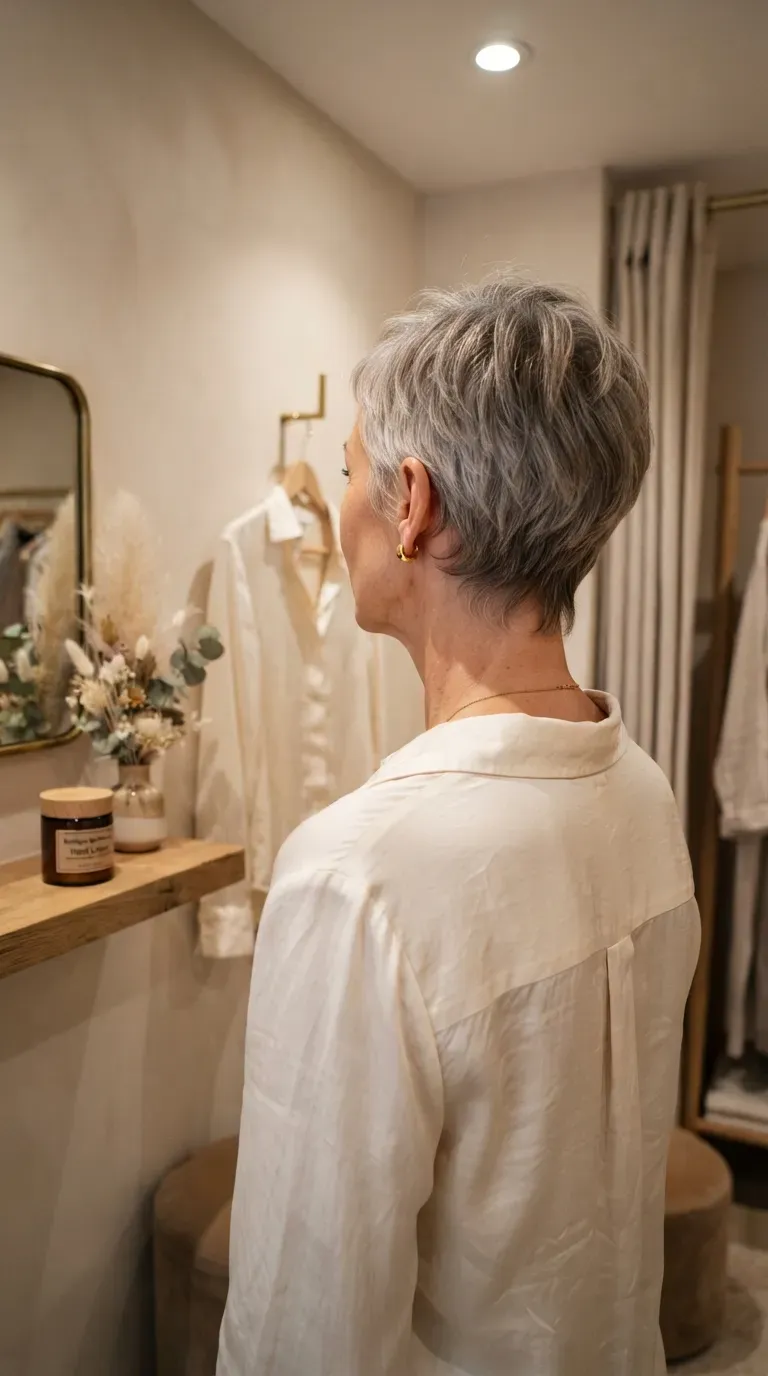
A cropped pixie with a softly feathered nape stays light and neat. About 1.5 inches on top, with a nape that’s been left slightly longer than a hard taper, keeps the back from looking too thin.
Ask for “a cropped pixie, 1.5 inches on top, with a soft, scissor-cut nape rather than clippered.” A hard clipper line can look severe on fine hair. Finish with a tiny amount of matte paste worked through the top.
If your nape hair is thin, don’t ask for a close taper there. It suits oval and heart faces and works best on fine, straight hair. Trim every 4 weeks, or the nape starts to look scruffy.
Quick checklist:
- Do: keep the nape soft and slightly longer.
- Do: use matte paste, not shine serums.
- Don’t: clipper-cut areas where hair is already sparse.
Browse our short back and sides alternatives and Who What Wear’s short hair edit.
Low effort, tidy finish.
7. Wavy Shag Pixie for Medium Density

A wavy shag pixie uses choppy layers to build movement, so medium-density hair looks fuller than a smooth cut. The layers overlap, which hides gaps and thin patches.
Ask for “a shaggy pixie with layers 2-3 inches long, textured with scissors, and a slightly longer fringe.” Scrunch in a light curl-enhancing mousse and diffuse for about 5 minutes. Avoid brushing when dry, which can flatten waves.
On humid days, it springs back nicely, which is why it’s a good everyday cut. It works best on wavy or slightly frizzy hair and suits round and oval faces. Very fine, flat-straight hair may need a texturizing spray to get the same effect. Trim every 6 weeks.
Pro Tip: Flip your head forward and shake the roots before you finish. It breaks up the layers and adds airy volume.
More ideas at our shag haircut guide and Vogue’s hair coverage.
Messy in the best way.
8. Gamine Pixie With Micro Bangs

Micro bangs sit about an inch long, cut just at the hairline, and pair with short sides. They concentrate density at the front, where a wider part or thin hairline is most noticeable.
Ask for “micro bangs about an inch long, cut slightly textured, with a cropped pixie behind.” This cut works best on fine to medium, straight hair and on oval or heart faces. If your hairline is receding at the temples, it can highlight that area, so discuss it with your stylist first.
I’d book a consultation before committing, because a fringe this short is hard to hide if you dislike it. Style with a small amount of matte paste, applied with fingertips only. Trim every 4 weeks.
Read our short bangs guide and Esquire’s grooming pages.
Short fringe, strong shape.
9. Silver Pixie With Chunky Highlights

Color can make hair look denser. Chunky highlights in a silver or pale-gray palette create light and dark zones that read as depth, so fine hair seems fuller than a flat, single-tone shade.
Ask your colorist for “soft, chunky highlights, 3-4 shades of blonde and gray, with a low-contrast root blend.” Highlighting a short cut is usually quick, and a gloss refresh every 6-8 weeks keeps brassiness away. Glosses typically run $40-90 at a salon.
Bleach can dry out already delicate strands, so ask for a gentle lightener and a bond-repair add-on. It works on any texture but is less ideal if your hair is already very brittle. Trim every 6 weeks.
Pro Tip: Ask for slightly darker tones underneath. They create a shadow effect that makes the top layer look thicker.
Pair with our silver hair styling guide and Byrdie’s color guides.
Depth does the filling.
10. Deep Side-Part Asymmetrical Pixie

An asymmetrical pixie keeps one side longer, about 3 inches, and swept over, with the opposite side cut closer. The deep part moves hair across the scalp and shifts attention away from a widening center part.
Ask for “a deep side part, 3 inches swept across, and a cleaner, shorter opposite side, blended with shears.” Medium to thick hair holds the shape best. On fine hair, the long side may look flat, so ask for a few short layers underneath.
A small tip from the chair: move your part to the opposite side each season so the scalp doesn’t see the same strain. It suits round and square faces and needs a trim every 4 weeks.
Compare skill and effort:
- Beginner: subtle asymmetry, 1 inch difference between sides.
- Advanced: a bold swoop with a close-cut side.
- Avoid: harsh clipper lines where hair is sparse.
See our asymmetrical cut ideas and GQ’s grooming advice.
A new part, a new balance.
11. Long Piecey Pixie With Soft Layers

A long pixie keeps about 4 inches on top with piecey, separated layers. It’s the gentlest way into a short cut, and the layers still create lift without losing styling options.
Ask for “a long pixie with 4 inches on top, layered with scissors, and sides cut just above the ears.” You can tuck, sweep, or pin it. Use a light texturizing spray, lifted at the roots with a round brush, and keep heat under 350°F (175°C).
If your hair has gone drier, avoid razor texturizing here, which can leave ends rough. It suits square and long faces, works on fine to medium hair, and needs a trim every 6-7 weeks.
Pro Tip: Bring a photo and ask your stylist to agree on a minimum length before cutting. It prevents surprise inches.
Read our long pixie styling guide and Elle’s styling stories.
A comfortable first step.
12. Curtain Bang Pixie With a Rounded Shape

Curtain bangs part in the center and sweep outward, which softens a pixie and frames the face. A rounded shape, where the crown has volume and the nape stays soft, avoids the severe lines that can make fine hair look sparse.
Ask for “curtain bangs about 3 inches long, blended into a rounded pixie with 2 inches on top.” Dry them with a small round brush, pulling outward from the center. Use a light heat protectant, and keep tools under 320°F (160°C).
Ask for the bangs a little longer than you want, as they shrink as they dry. They suit heart and long faces and work on fine, straight to slightly wavy hair. Very curly hair may split at the part. Trim every 5 weeks.
Explore our curtain bangs guide and Allure’s bang advice.
A soft frame for the face.
13. Blunt-Cut Pixie for Fine, Straight Hair

A blunt-cut pixie uses minimal layering, with ends cut straight across. On fine, straight hair, that gives a dense, clean edge that reads as thicker than a heavily layered cut.
Ask for “a blunt, precise pixie with only light internal layers, about 2 inches long.” Add a few drops of lightweight shine serum for polish, not heavy oil. Use a volumizing shampoo and avoid silicone-heavy conditioners at the roots.
It’s an unforgiving cut, because any uneven line shows, so choose a stylist who’s confident with precision. It suits oval and long faces and needs a trim every 4-5 weeks to keep the line crisp.
Pro Tip: Blow-dry in the direction you want the lines to fall, using a vent brush. Precision cuts need smooth drying.
See our blunt cut ideas and Harper’s Bazaar’s short hair features.
Sharp lines, solid look.
14. Dimensional Balayage Pixie

Balayage on a pixie is hand-painted, so the lighter pieces sit where light naturally hits. That creates dimension and the look of thickness, especially on fine to medium hair.
Ask your colorist for “soft balayage, 2-3 shades lighter than my base, concentrated on the top and fringe.” It’s a good option for gray coverage, too, since the blend hides regrowth. Expect a cost of roughly $80-180, depending on the salon.
Dimension looks best when the base is healthy, so choose a gentle lightener and a bond-repair treatment if hair feels dry. It suits oval and round faces. Trim every 6 weeks, with a gloss refresh every 8-10 weeks.
Variation ideas:
- Subtle: one shade lighter, fringe only.
- Brighter: two shades lighter, all over the top.
- Avoid: high-contrast stripes, which can make fine hair look patchy.
Browse our balayage for short hair ideas and Who What Wear’s color picks.
Light placed where you need it.
15. Wash-and-Go Pixie for Coarse, Wiry Hair

Coarse, wiry hair often gets frizzy and hard to control as it ages. A short, forgiving pixie with 2 inches on top lets it dry into a natural shape with almost no styling.
Ask for “a relaxed pixie cut with soft, uneven layers, 2 inches on top, tapered sides.” A moisturizing leave-in cream and a tiny amount of oil, run through damp hair, tame the frizz. Let it air-dry for most days.
It’s the cut I’d suggest to anyone who is tired of daily styling. It works on coarse, straight to wavy hair and suits most face shapes. Trim every 5-6 weeks, and use a hydrating mask once a week.
Pro Tip: Wring your hair gently with a microfiber towel, not a regular terry one. It cuts down frizz as it dries.
Check our easy short haircuts and the American Academy of Dermatology’s hair care advice.
Easy mornings are the goal.
16. Brushed-Up Quiff Pixie

A quiff pixie keeps about 3 inches at the front and brushes it up and back. That lift pulls hair away from the scalp, which helps hair look fuller at the front hairline.
Ask for “a pixie with 3 inches at the front, short sides, and enough length to brush up and back.” Blow-dry with a small round brush, then set with a light-hold paste or mousse. Heavy gel can leave scalp visible, so skip it.
This works on medium, straight hair and suits oval and diamond faces. On very fine hair, it may need a root-lift spray. Trim every 4-5 weeks to keep the shape.
Quick guide:
- Best for: adding lift at the front hairline.
- Product: mousse or light paste.
- Avoid: heavy gel or wax that weighs it down.
See our quiff and swept-back ideas and Esquire’s grooming guides.
Lift where it counts.
Getting Started With Pixie Cuts for Menopause Hair Changes
The easiest first step is a consultation. Many salons offer them free or for around $10-25 credited toward the cut, and it’s the best time to ask how your hair’s density, texture, and growth patterns will affect the shape. Bring two or three photos, including one you don’t like.
The most common beginner mistake is asking for lots of layers, hoping for volume. On fine hair, too many layers can make it look sparser. Aim for strategic layering at the crown and a solid outline instead. Keep your first cut slightly longer than your goal, and go shorter next time.
Book one thing first: a stylist who’s comfortable cutting short, fine, or coarse gray hair. Then buy one product, a lightweight root-lift mousse ($10-25). Skip anything heavy for the first month.
Expect results immediately in terms of shape, and a feel for the cut after two or three washes. Pixies need a refresh every 4-6 weeks, and growing one out takes about 12-18 months. If you notice sudden or patchy shedding, talk to a doctor or dermatologist.
Frequently Asked Questions
What is the best pixie cut for menopause hair changes?
A soft layered pixie with 2.5-3 inches on top and a textured fringe suits most fine, thinning-looking hair. Coarse gray hair does better with a tapered cut and slightly longer top. A stylist can tailor it to your density and face shape.
Do pixie cuts make thin hair look fuller?
Yes, often. Short lengths lift off the scalp, and crown layers add height. They can’t change actual density, though, so very sparse areas may still show.
How often should I trim a pixie cut for fine hair?
Every 4-6 weeks keeps the shape crisp. Asymmetrical or undercut styles may need a visit every 3-4 weeks. Longer pixies can stretch to 6-7 weeks.
Is a pixie cut good for gray, wiry hair?
Yes, especially a tapered or relaxed cut with 2-3 inches on top. Short lengths are easier to moisturize and smooth. Use a hydrating leave-in to keep frizz down.
Which products work best for pixie cuts with menopause hair changes?
Lightweight root-lift mousse, a moisturizing shampoo, and a small amount of matte paste work well. Avoid heavy waxes and gels, which can weigh hair down. If your scalp feels irritated, check with a dermatologist.
A Few Final Thoughts
These 16 pixie cuts for menopause hair changes show that a shorter cut doesn’t mean giving something up. The right shape, matched to your texture and face, can make hair look fuller and healthier than a long, tired length ever did. Start with a consultation, bring photos, and be honest about what bothers you most.
Hair changes can feel unsettling, but a small change can reshape how you see yourself. Book the appointment, tell your stylist exactly what you want, and let your new cut do the work.